Because humans have been far removed from wild spaces for quite some time, we’ve also experienced a simultaneous disconnect from the creatures that inhabit them, resulting in a unique dichotomy where we are both charmed and challenged by their presence.
Artists have helped bridge this gap by bringing the public unique ways in which to view our non-human counterparts. They bring wildlife into “our” world in a variety of beautiful ways, calling upon us to not forget what we once knew so intimately, and teaching us to be more mindful and empathetic.
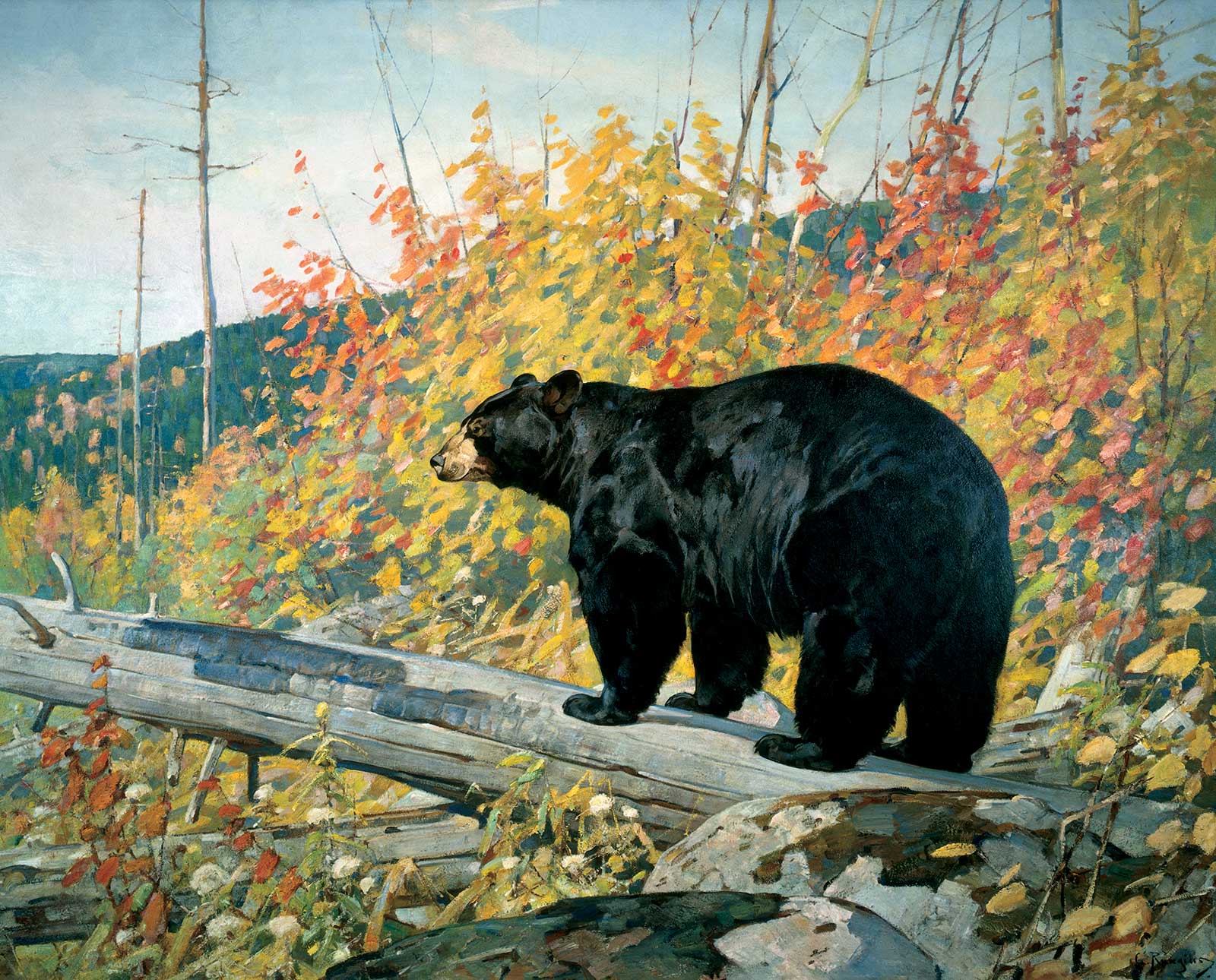
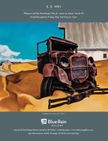
National Museum of Wildlife Art, American Black Bear, 1929, oil on canvas, 61 x 76”, by Carl Rungius (1869-1959). Gift of the Jackson Hole Preserve, National Museum of Wildlife Art. © Estate of Carl Rungius.
Artist Julie T. Chapman draws us in with a style she calls “disrupted realism.” She explains that, “The fragmented, ‘incomplete’ aspect of these paintings is my response to the chaos and change that is everywhere in our environment—social, political, natural. Many of the paintings are intended to confront the viewer, to spur us to ask questions of ourselves and of each other.”
For her mixed media pieces like What the Cat Knows,she shares: “Cougars—those cats of many names—often feature in my paintings as symbols of both mythology (think Artemis) and wildness. Cats are famous for being inscrutable, and cougars are no exception. This one was alerted to something unknown, and her face was beautifully modeled by the morning light. This painting is also an experiment with a red-green color harmony—fun to do with the pale, monochromatic coat of our biggest wild cat.”
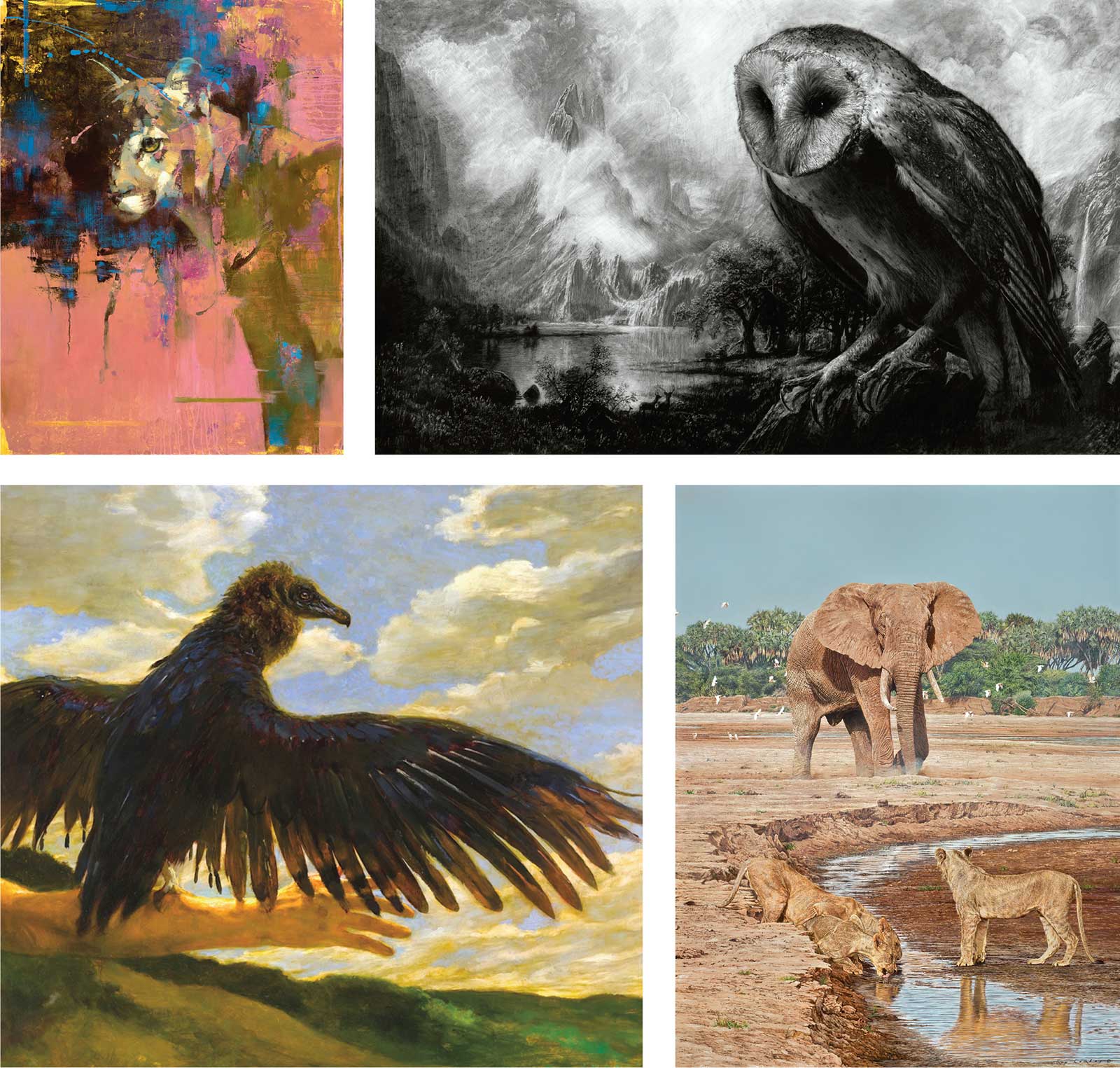
TOP: Gallery Wild, What the Cat Knows, mixed media, 40 x 30”, by Julie T. Chapman; RJD Gallery, Guthrie, charcoal and water mounted on deep canvas, 42 x 68”, by Tyler Vouros. BOTTOM: RJD Gallery, Me and My Vulture, oil on board, 28 x 31”, by Jamie Wyeth, Guy Combes, Power Play, oil on canvas, 60 x 46”
Going back to the beginning, we see artists compelling us very early on. National Museum of Wildlife director, Steve Seamons, echoes that “animals were some of the first subjects that prehistoric humans depicted in cave paintings, and they continue to resonate with us today. Through art, we strive to impart knowledge and generate wonder to inspire connections with wildlife and nature. Wildlife art is at the heart of everything we do. Our collection of over 5,000 cataloged works spans centuries from 2,500 B.C.E. to the present.”
Seamons adds that the museum is home to the most extensive collection of Carl Rungius (1869-1959) paintings in the United States, and they are currently creating a catalogue raisonné for the artist that's regarded as the preeminent painter of North American wildlife. “Commissioned by the New York Zoological Society, Rungius created a series of paintings of North American mammals for their headquarters in the Bronx,” says Seamons. American Black Bear(pictured here) comes from this project and represents Rungius’s shift towards impressionism. In this painting, Rungius balances the society’s need for anatomical accuracy with the vibrant colors and bold brushstrokes of his evolving style.”
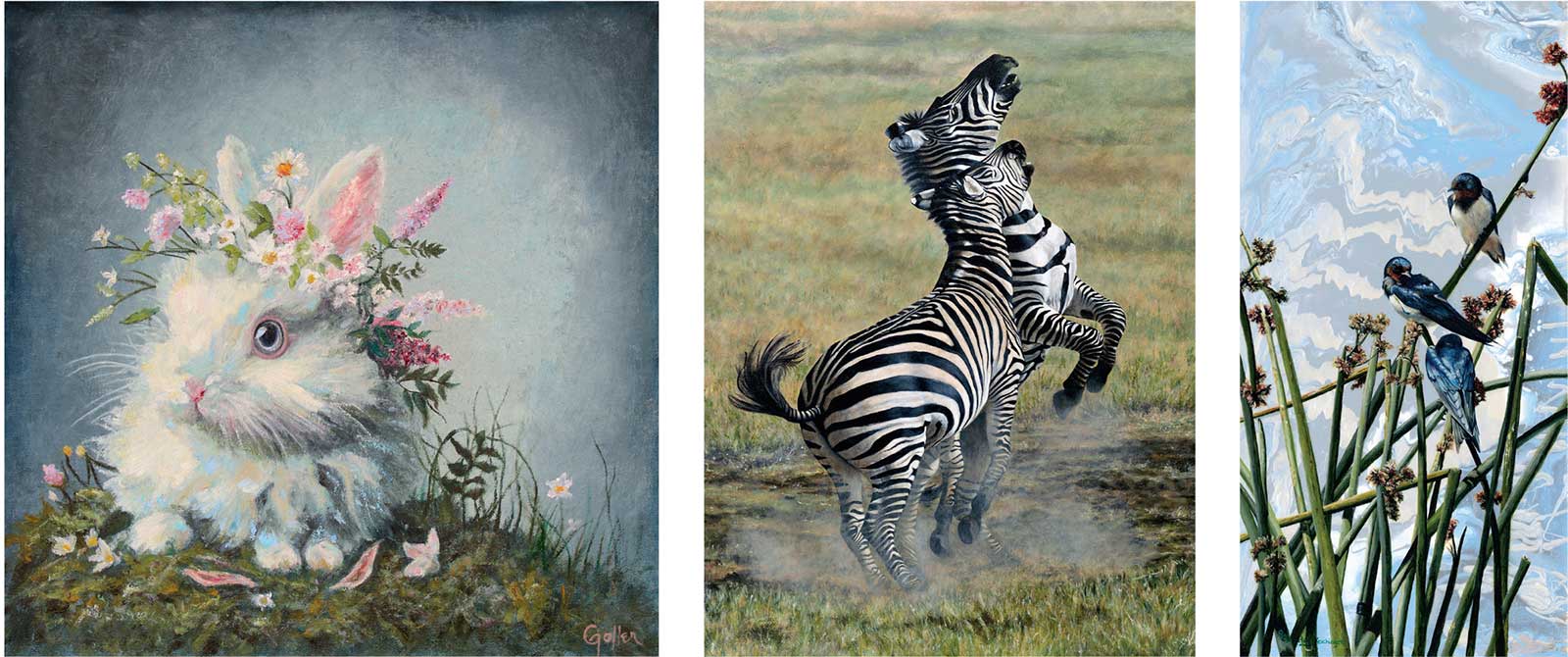
Carrie Goller Gallery, Fern (Floriferous Collection), oil, 10 x 10”, by Carrie Goller; Cindy Sorley-Keichinger, Contested, acrylic, 24 x 18”; Cindy Sorley-Keichinger, Swallow Dream, acrylic, 18 x 9”
Known for his realistic portrayals of wildlife subjects inspired by his years growing up in Kenya, artist Guy Combes offers up delights like Power Play. “Severe drought brings some of the most charismatic species uncomfortably close,” explains Combes of the oil painting. “In this “power play,” I wanted to capture the moment where some thirsty lions drink as much precious water from the remaining trickle of the Ewaso Nyiro before a bull elephant intimidates them enough to scatter to safety.”
Combes has also attracted a following for his conservation activism, so there is an added layer of narrative that is significant to his work. “As a wildlife artist, I’m always aware of the importance of celebrating these beautiful animals as a way of defending their freedom” he says. “[And] when I’m considering painting compositions based on my lifetime of knowledge of the East African ecosystem, it’s always important to me that each painting tells a story.”
The story, like for so many others in this section, is one of compassion, integrity and a beautiful reconciliation with our many wild neighbors.
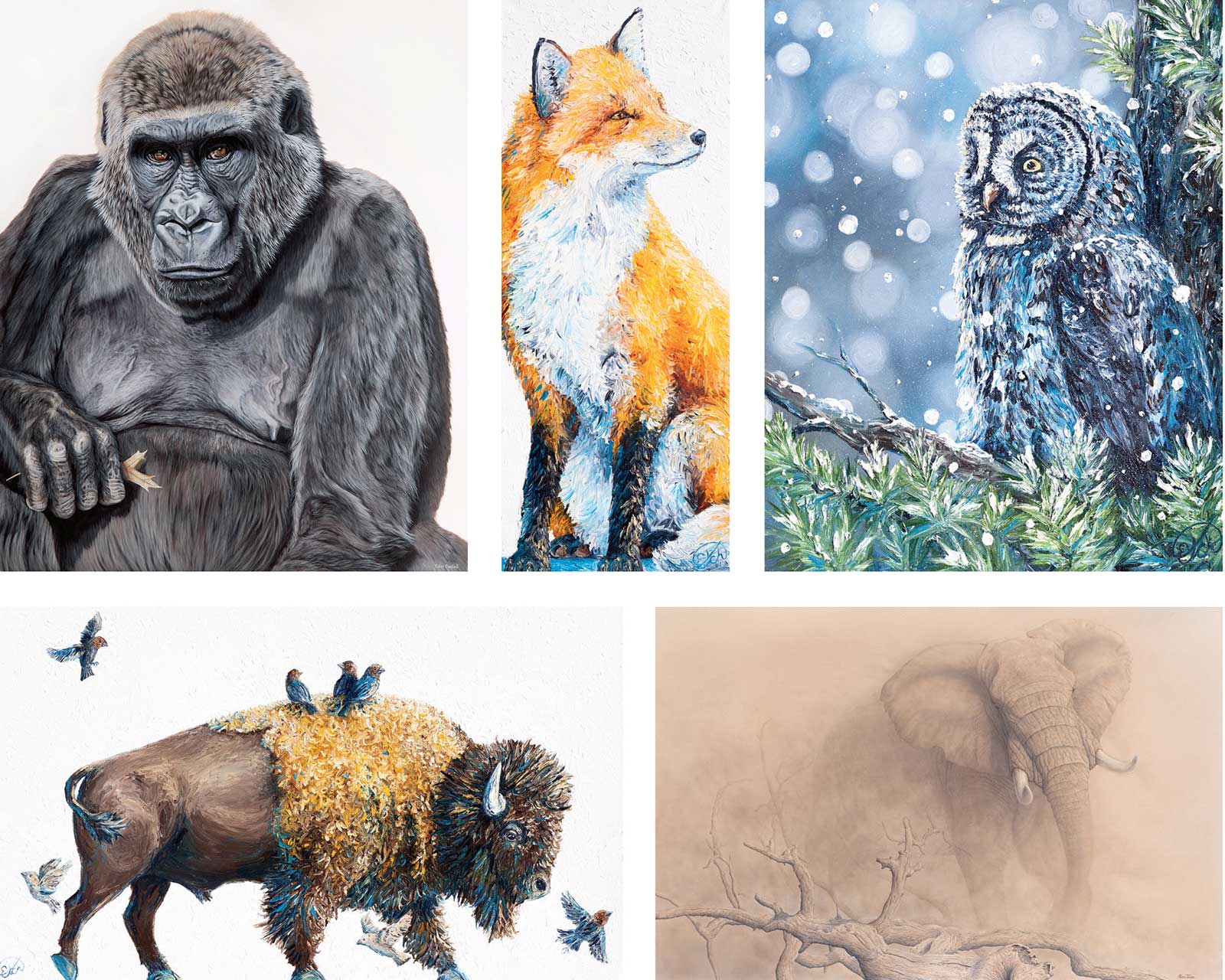
TOP: RJD Gallery, Sol Lucet Omnibus, acrylic on canvas, 36 x 30”, by Esther Curini; Elizabeth Mordensky, Curious, oil finger painting, 40 x 16”; Elizabeth Mordensky, Winter Ponderings, oil finger painting, 30 x 24”. BOTTOM: Elizabeth Mordensky, The Birds and The Beast, oil finger painting, 36 x 60” ; Renso Tamse, African Dust, watercolor, 45 x 65”
Throughout the remainder of this section, you’ll hear from additional artists, museums and galleries on the many magical nuances that make up the wildlife genre.
“It is difficult to find a better muse for art than wildlife,” claims Richard Demato, owner of RJD Gallery, based in Romeo, Michigan. “Wildlife is a joy to behold; it stirs our curiosity and delights our senses. It reminds us of the interconnectedness of all sentient beings and our role in preserving earth’s biodiversity. Wildlife can enhance and refresh to an art collection giving balance and variety and giving a ‘pop’ to any grouping.”
Esther Curini’s Sol Lucet Omnibus presents a primate peering from the canvas with a gaze that is both daunting and gentle; a true “I am who I am” moment. The title translates to “the sun shines for everyone” and Curini reminds us that this phrase includes wildlife. Tyler Vouros draws inspiration from the natural world, a place where he has felt most at home since childhood. His muses are almost all birds of prey, raptors from a local bird rehabilitation center including Guthrie. He describes his work as an exploration of “visual world-building using flora and fauna, set within old master landscapes.” Jamie Wyeth’s Me and My Vultureis a stunning example of the artist’s distinctive style and his animal portraits. Wyeth rescued the vulture that now circles the island where he lives and was the inspiration for the artwork.”
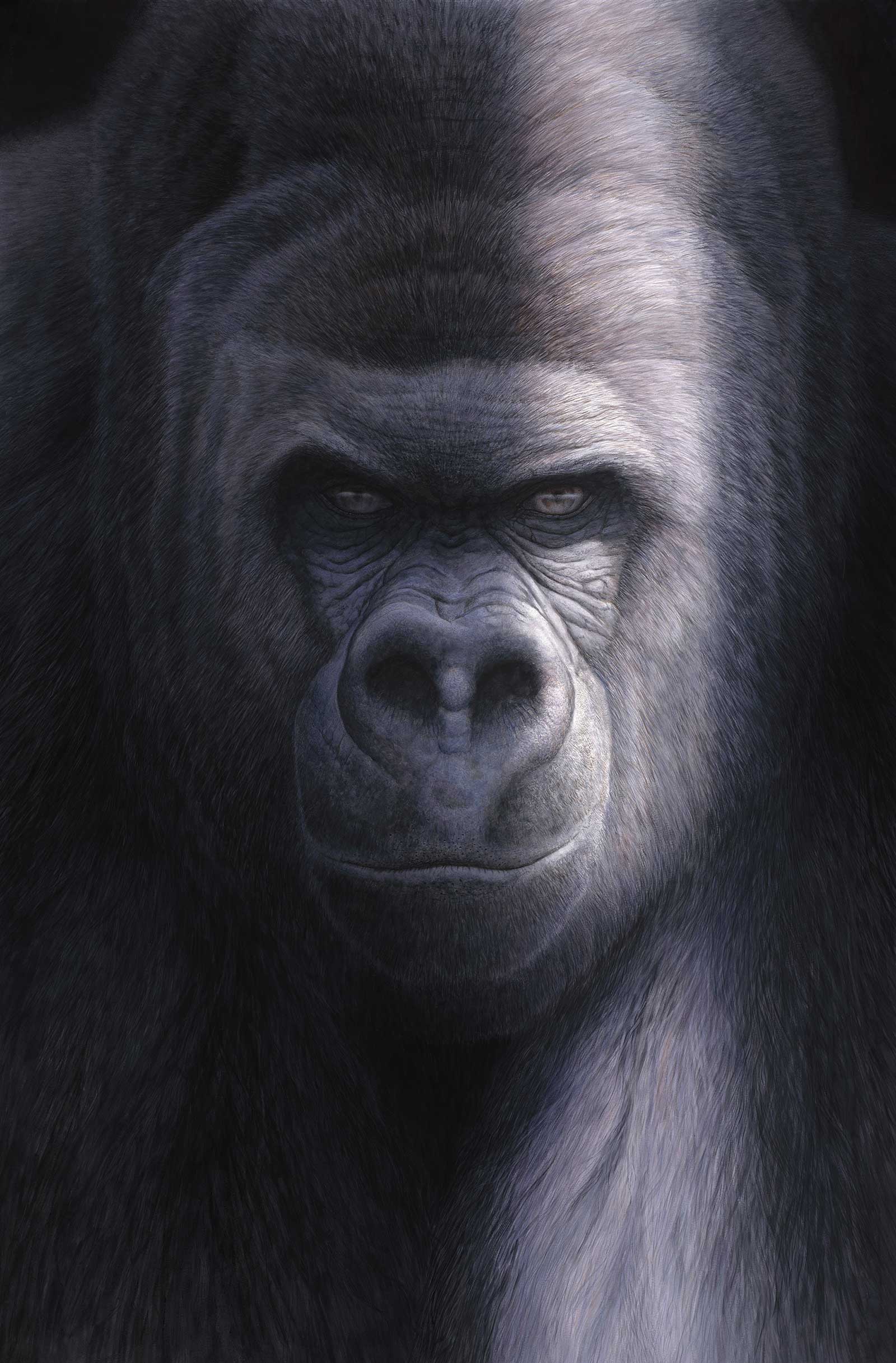
Renso Tamse, Significance of Strength, watercolor, 95 x 60”
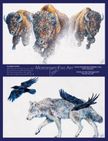
Living on the borders of Yellowstone National Park, contemporary wildlife artist Elizabeth Mordensky finds no shortage of inspiration. Her work as a wildlife guide in the park allows her to observe the behavior, movements and characters of the animals of the Western Unites States in spectacular detail. Her highly textured oil finger paintings bring the subjects to life in a unique way. She is becoming well known for her approach to capturing winter wildlife, incorporating a bokeh effect to achieve depth of field in her snow scenes, and building texture and movement of snow flying off the canvas in others. From the wild energy of bison charging through the snow to the peaceful silence of a heavy snowfall, Mordensky has found a way to truly bring these moments to life.
When looking for the perfect piece of art to complement your home, Mordensky believes it is much more about how the piece speaks to you, rather than following a particular color scheme or design aesthetic. “The art itself will make a room,” she says, “and is quite adaptable to any space. What you truly want is a piece that sparks interest and joy when you look at it.”
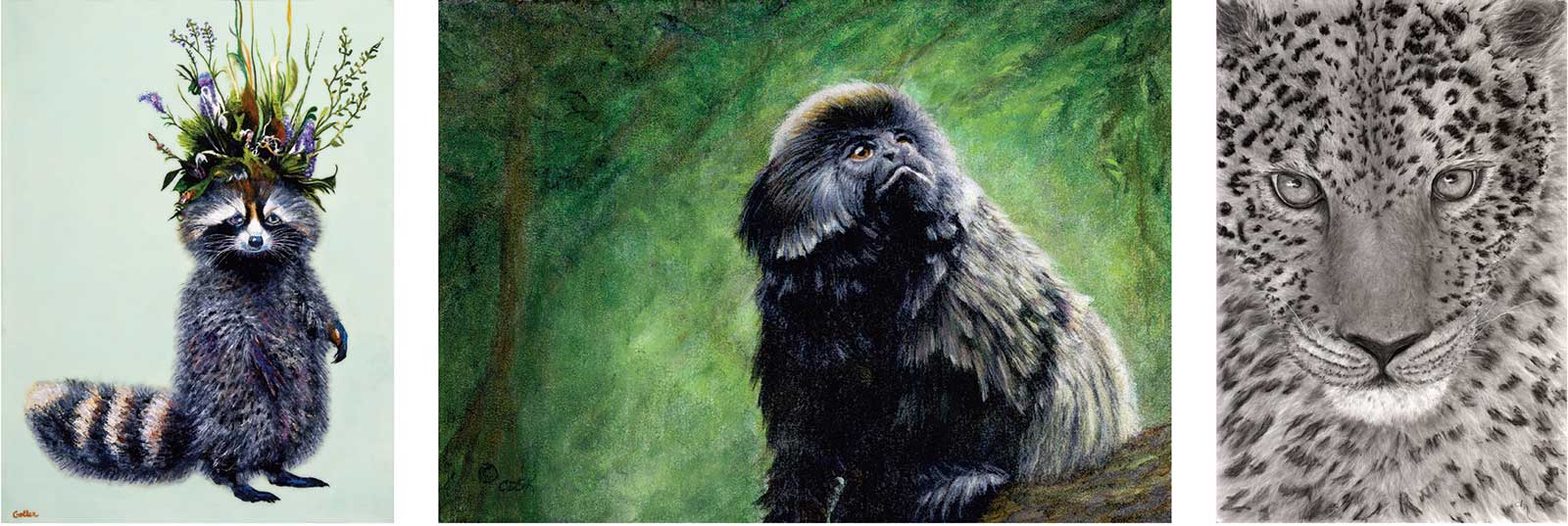
Carrie Goller Gallery, Rambo (Floriferous Collection), mixed media, 24 x 18”, by Carrie Goller; Cindy Sorley-Keichinger, Geoldi’s Monkey, acrylic, 5 x 7” ; Tamara Nelson, Layla, mixed media, 18 x 12”
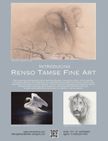
Since he was a young child, artist Renso Tamse felt a strong connection to all wildlife. “A great deal of my work focuses on endangered species,” he says, “and I want my paintings to serve as a reminder of our responsibility to protect and cherish the fragile wonders of the natural world, and the extraordinary animals that call it home. So, I try to bring out the spirit of the animal in a way that can move people to action to preserve these magnificent creatures and their habitat.”
We see Tamse explore these themes in watercolor works like African Dust, featuring an elephant kicking up dirt; Significance of Strength—a highly detailed view of a gorilla; and Dance of the Cranes, showing a triptych of graceful, dancing cranes.
When collecting, Tamse says, “As with any piece of art, select something that moves you, that stirs something inside your soul. What is your Spirit Animal? Buy or commission a painting of that animal and each day, as you walk past it on your wall, it will connect you with nature and re-energize your spirit.”
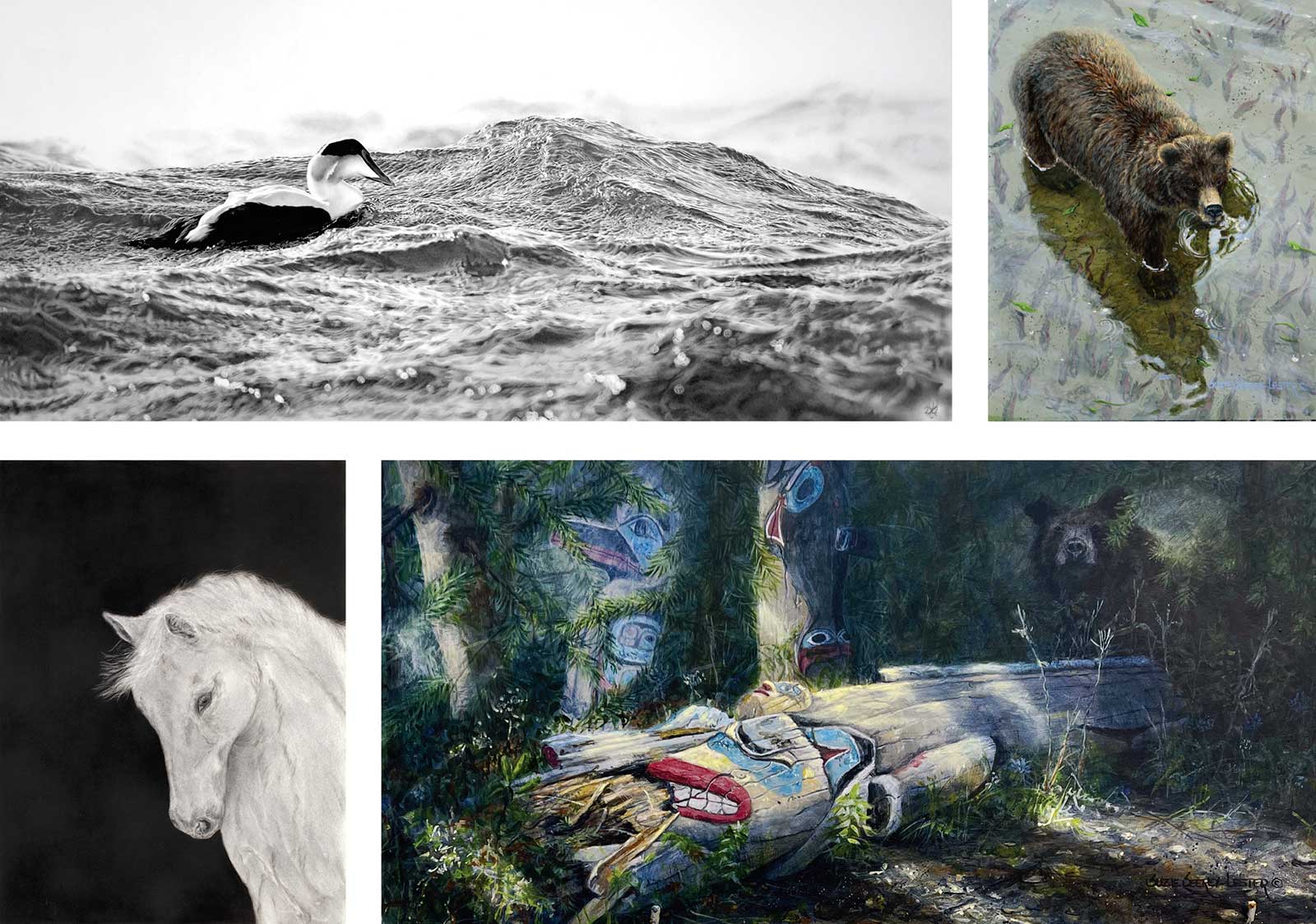
TOP: Jamie Cassaboon, Common Elder #1, graphite on paper, 15 x 32”; Suzie Seerey-Lester, Snack Food, acrylic, 14 x 11”. BOTTOM: Tamara Nelson, Ghost, mixed media, 24 x 18”; Suzie Seerey-Lester, Kindred Spirits, acrylic, 16 x 20”
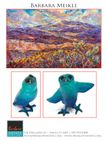
For artist Carrie Goller “exploration is oxygen.” One way she satisfies that need is by working in mediums as diverse as her subject matter. In addition to landscapes, seascapes and still life, Goller has a large body of work that focuses on the animal kingdom—from sweet, whimsical birds wearing crowns of flowers to small creatures like rabbits and squirrels, to farm animals, horses, wolves and more. Working in mediums that include oil, cold wax, encaustic and egg tempera, she places her subjects in realistically rendered landscapes as well as more abstract backgrounds.
Mentored by Max Hayslette and having studied under renowned artists such as Brad Kunkle, Juliette Aristides, Gabriel Lipper, Jim Lamb and Ned Mueller, her work reflects a blend of classical and experimental approaches, drawing inspiration from nature’s organic forms and vibrant colors.
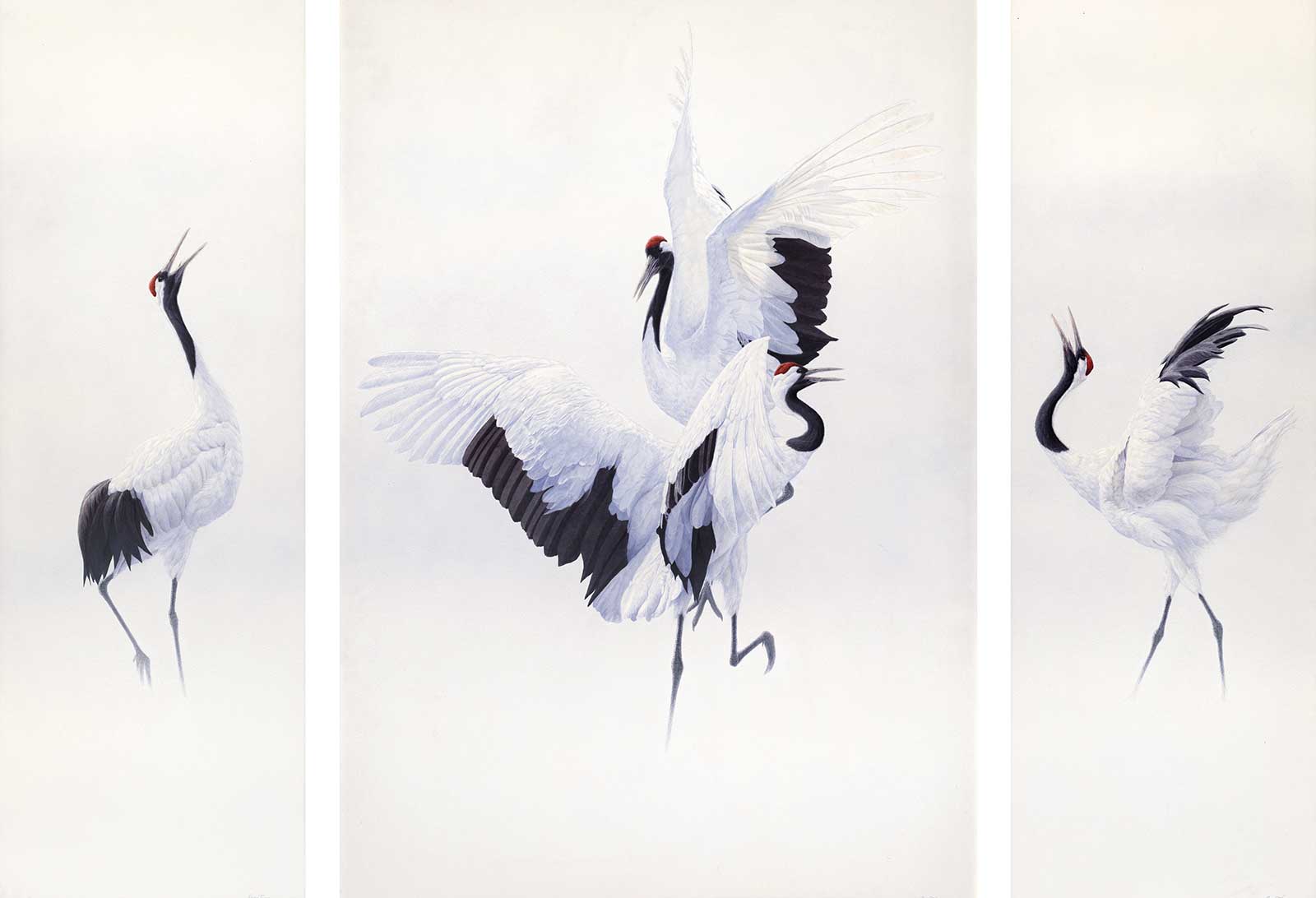
Renso Tamse, Dance of the Cranes, watercolor on board, 63 x 87”
Her delightful work can be found at Carrie Goller Gallery in Poulsbo, Washington, as well as in private and corporate collections worldwide. Goller has exhibited in museums and galleries in Washington, Arizona and California, and she is a signature member of Artists for Conservation.
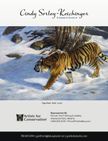
Cindy Sorley-Keichinger is a primarily self-taught artist, with her work reflecting a deep love of nature and wildlife. “In these trying times, it is nice to enjoy the peace of nature and scenes of animals,” she says. “A study has found that paintings of nature and wildlife have a calming effect on people, and some workplaces have brought in nature walks to help their staff to relax.” Sorley-Keichinger tries to bring this serenity into her work.
She is a member of several Artist Organizations including Artists for Conservation, Society of Animal Artists and Women Artists of the West, to name just a few. She is also proud to have designed a coin for the Royal Canadian Mint. Find her work at the Masterpieces in Miniature— the largest small works show in Canada—at Picture This Gallery in Sherwood Park, Alberta, for the month of May 2024.
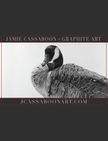
Jamie Cassaboon’s work starts with observation, and as a wildlife artist, he is always first inspired by the natural world. “Working monochromatically—in graphite—presents some unique challenges, and requires an even greater attention to the other elements of art in the absence of color in order to draw the viewer in,” Cassaboon says. “Composition and light become even more significant. But, in addition to these, I find that the story and energy of the piece become paramount. I am attracted to that captured moment that still carries the movement and action that allows viewers to engage with the story as it unfolds, and to imagine that unfolding.”
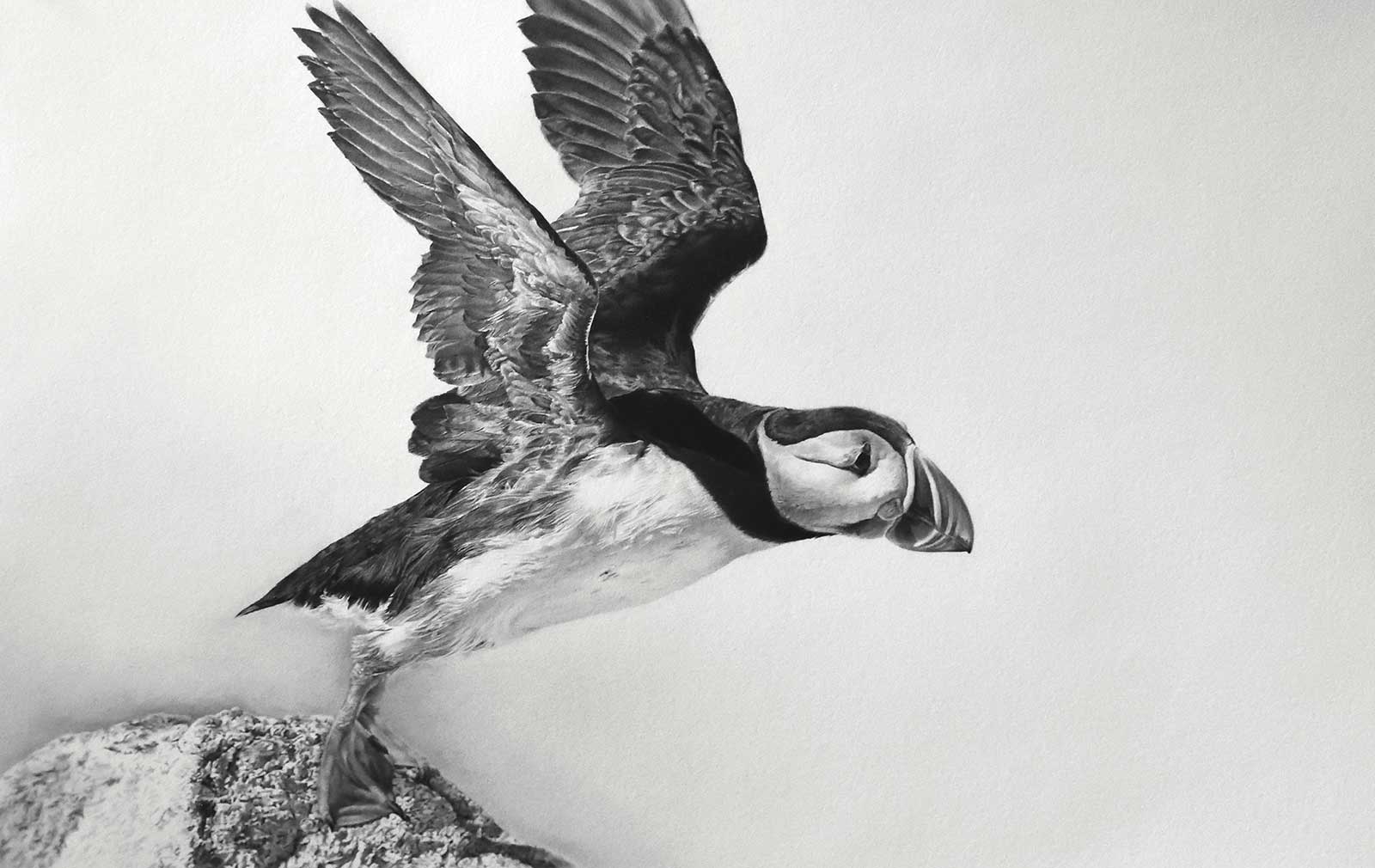
Jamie Cassaboon, Atlantic Puffin #1, graphite on paper, 15 x 22”
Cassaboon’s use of realism affords the opportunity to not only view the broader scene, but also to approach and engage with the textures and layers of the precise as well. Repeated views over time can continue to illuminate new appreciations or discoveries, as well as viewing from different angles and distances.
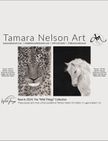
Tamara Nelson approaches each project looking for new, unique ways to convey her vision, and blends a multitude of disciplines, while breaking the rules to create her final pieces—working with traditional oils, charcoal, pastel, acrylic, resin and everything in between to achieve the final results. Her new Wild Things collection is born from her love of animals and to draw attention to the endangered wildlife here and abroad. “To try and capture the beauty of these animal’s is a journey and a passion,” she remarks.
Nelson also works with commercial interior designers creating custom pieces for their projects working from specification books showing the room concepts she creates pieces for each project to complement the space. Nelson also has her own award winning, one-artist gallery in Laguna Beach, California.
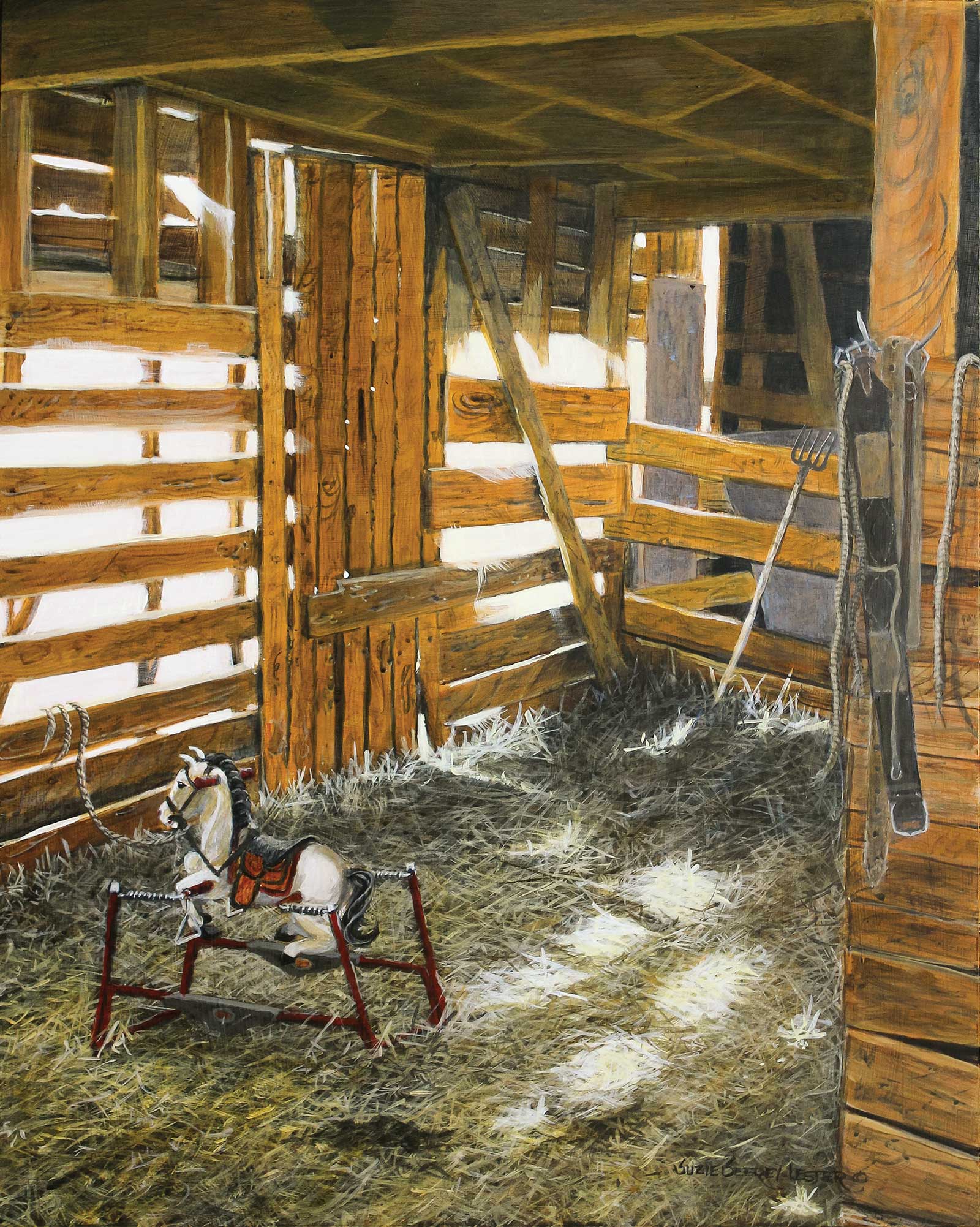
Suzie Seerey-Lester, Hi Ho Silver, acrylic, 20 x 16”
Known for her remarkable barns and birds, is the international award-winning wildlife artist Suzie Seerey-Lester. Her acrylic works include mysterious backgrounds that have you looking for hidden animals—inspiring you to take a second look, and then another. Seerey-Lester has traveled all over the world to paint amazing subjects, and will only paint animals she has seen in the wild.
Pictured here, you’ll find whimsical works like Snack Food, of a bear finding food in water; Kindred Spirits, that features a totem pole with a surprise face peeking through the right corner of the painting; and Hi Ho Silver depiciting one of the artist’s classic barn scenes.
Seerey-Lester’s works can be found at Trailside Gallery, Native Visions, The Plainsmen Gallery and Gallery by SEWE. —
Featured Artists & Galleries
Carrie Goller Gallery
18801 Front Street, Poulsbo, WA 98370
(360) 79-2388, info@carriegoller.com
www.carriegollergallery.com
Cindy Sorley-Keichinger
(780) 847-2294,
goldfarm@telusplanet.net
www.goldenkstudio.com
Elizabeth Mordensky
(406) 219-8307
www.mordenskyfineart.com
Gallery Wild
80 W. Broadway Avenue Jackson, WY 83001
(307) 203-2322
info@gallerywild.com
203 Canyon Road
Santa Fe, NM 87501
(505) 467-8297
santafe@gallerywild.com
www.gallerywild.com
Guy Combes
www.guycombes.com
Jamie Cassaboon
jcassaboonart@gmail.com
www.jcassaboonart.com
National Museum of Wildlife Art
2820 Rungius Road, Jackson, WY 83001
(307) 733-5771, www.wildlifeart.org
Renso Tamse
+1 (703) 624-7470
www.rensotamse.com
RJD Gallery
227 N. Main Street, Romeo, MI 48065
(586) 281-3613
art@rjdgallery.com
www.rjdgallery.com
Suzie Seerey-Lester
seereylester@msn.com
www.seerey-lester.com
Tamara Nelson Art Gallery
305 N. Coast Highway, Suite E
Laguna Beach, CA 92651
(949) 510) 6602
info@tamaranelsonart.com
www.tamaranelson.com
Powered by Froala Editor